
What it is
The current version of the Internet Protocol
IPv6 replaces IPv4 with 128-bit addresses — enough globally-unique, non-overlapping addresses for any imaginable IT environment, with no need for NAT.
IPv6 has surpassed IPv4 as the most-used Internet Protocol. For most enterprises the question is no longer whether to deploy it, but when — and how much effort it will take. This free guide answers both.

We never sell or share your address. Unsubscribe any time.
IPv6 in 60 seconds
Most people land here after searching for an IPv6 test, their IPv6 address, or just ‘IPv6’. Here is the short version of what it is and why it matters — and then the question nearly every enterprise network team ends up asking: not whether to deploy it, but when.
What it is
IPv6 replaces IPv4 with 128-bit addresses — enough globally-unique, non-overlapping addresses for any imaginable IT environment, with no need for NAT.
What an address looks like
Eight groups of hexadecimal separated by colons, with runs of zeros collapsed to ‘::’. If your check above showed one, that is your public IPv6 address.
Who is using it
Roughly half of the ~4 billion devices reaching Google use IPv6. More than 30 countries already see more IPv6 traffic than IPv4.
Why enterprises care
Less latency without NAT, better security visibility, and a transition with no IPv7 behind it. Germany targets 2030; the Czech Republic plans to disable IPv4 on government services by 2032.

Your device may already be on IPv6. Your enterprise network probably isn't yet. The guide is about closing that gap on a schedule your teams can live with.
Get the free guideWhat is inside the guide
01 · The case
Measurable performance gains without NAT, and globally-unique addresses for any imaginable IT environment.
02 · The evidence
IPv6 has surpassed IPv4 to become the most popular Internet Protocol, with the Google and APNIC numbers behind it.
03 · The reality
There is no IPv7 on the horizon. With the Internet past 50% IPv6, we are in the late majority stage of adoption.
04 · The roadmap
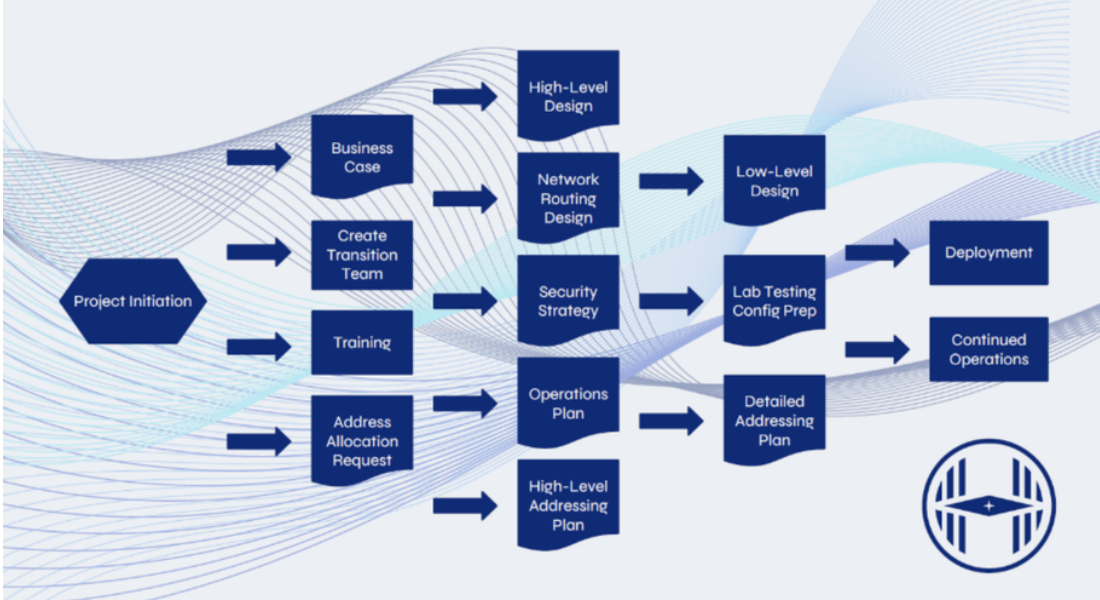
The phases most enterprises follow, the RFC 7381 guidance, and why IPv6 must be an officially recognized program.
05 · The numbers
A sample 12-quarter work breakdown structure: 1,533 days, 12,264 staff hours, and the OPEX estimate behind it.
06 · The sweet spot
5%, 10% or 20% of staff time — what each means per person, per year, and for your finish date.
07 · In summary
Start right away, make progress, and interleave IPv6 with your other projects.
From the guide
Thirty IT staff, a 12,264-hour work breakdown structure, and three ways to pace it. The guide shows how each choice changes the finish date — and what the Internet will look like when you get there.
5%
Too little
2 hrs/week · finishes ≈ 2031
10%
Just right
4 hrs/week · finishes in ~2 years
20%
Too much
1 day/week · ~1 year, competing work
